
Issaquena County Arrest Records and Court Charges
An Issaquena County arrest record documents the arrest itself. It typically notes who was taken into custody, the arresting agency, the date and place of the arrest, and the booking that follows at the jail. In this county the sheriff's office handles that side. The record reflects what officers alleged at the time. It does not decide guilt, and it is not the same as a filed charge. After an arrest, the case moves to the prosecutor. The district attorney reviews the facts and decides which formal charges, if any, to file with the Circuit Clerk. Those filed charges become the court charge record.
The two records sit in different places. Arrest and booking details belong to law enforcement, so the jail roster and custody status are covered on the Issaquena County inmate records page. The court charges after arrest belong to the court file, opened once the prosecutor submits a charging document. Issaquena County does not run a public mugshot or booking database online, so the charge record is usually the searchable trail that shows what a person was actually accused of.
The Issaquena County Sheriff's Department is the starting point for arrest and booking questions, and its official roster of contacts appears on the town's Issaquena County Sheriff's Department page.
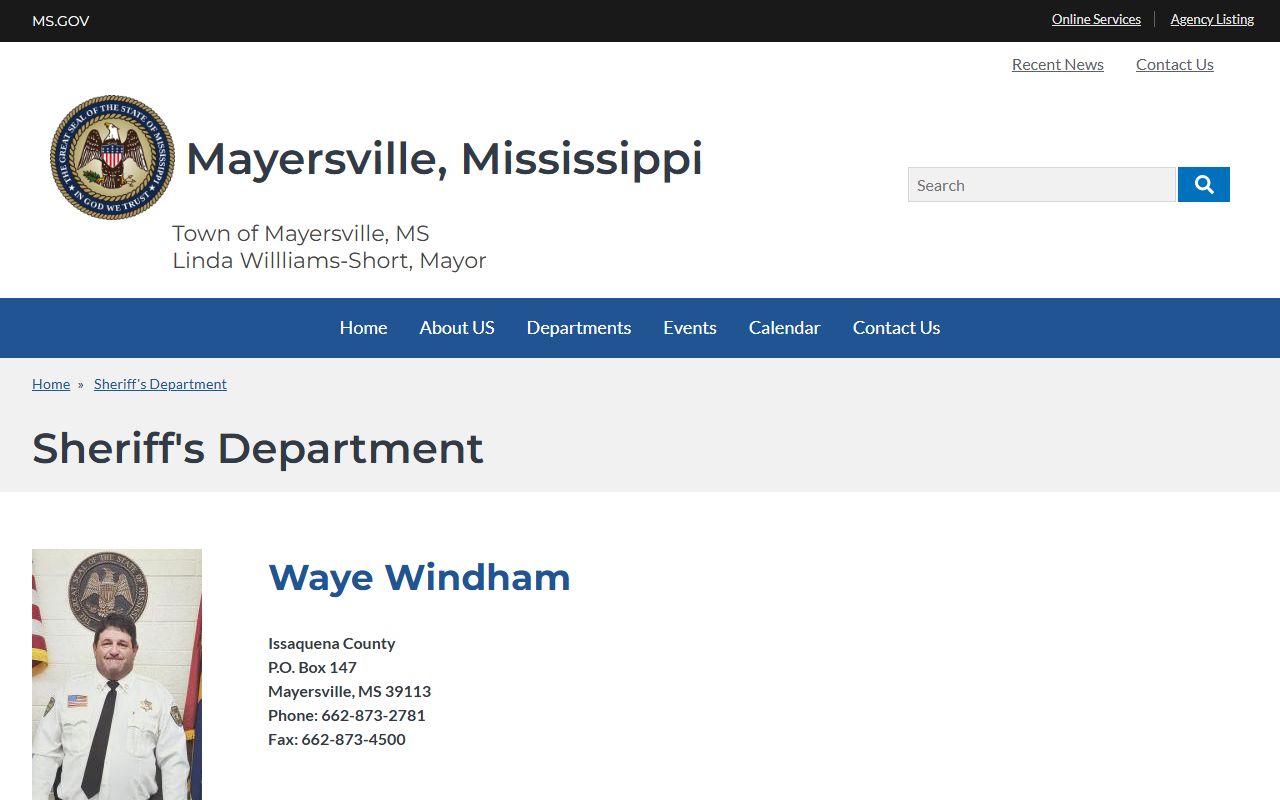
Sheriff Waye Windham's office can confirm a recent booking by phone at 662-873-2781, since no local arrest database is posted for public search. The county correctional facility can be reached separately at 662-873-2153.
How to Find Issaquena County Arrest Records and Charges
Most filed charges in Issaquena County show up in the court case record, not in a separate arrest log. Circuit and Chancery cases are managed through Mississippi Electronic Courts, and the public views them through Public Access to Mississippi Electronic Courts, known as PAMEC. The county runs no standalone case-search portal, jail roster, or warrant page of its own. PAMEC requires a public account, and remote document viewing carries a charge. Anyone who would rather not register can read public filings at the courthouse in Mayersville or call the Circuit Clerk for help.
- Decide which court holds the case. Felony charges sit in Circuit Court, while misdemeanor and traffic charges often start in Justice or Municipal Court.
- For Circuit or Chancery matters, open the Ninth Circuit or Ninth Chancery MEC system and register through PAMEC for remote access.
- Search by the defendant name or the case number once the public account is active.
- Open the case and read the charge list, checking each charge's statute code, level, and current status.
A filed charge is local court data. Once a person is sentenced to state custody, the record also surfaces in Mississippi Department of Corrections tools, which are custody lookups rather than charge databases. The courthouse remains the single fallback when a file is old, sealed, or not yet digitized.
Filing Issaquena County Charges After an Arrest
An arrest does not create a court charge on its own. The charge record begins when a prosecutor files a charging document with the clerk. In Mississippi, three documents do that job, and which one applies depends on how serious the offense is and which court hears it. For felonies in Issaquena County, the case runs through the Ninth Circuit Court District, where District Attorney Ricky Smith prosecutes. His office reviews arrests, presents felony cases to a grand jury, and signs the indictments and plea orders that drive the charge record. The district attorney can be reached at 601-636-5754.
| Complaint | Information | Indictment | |
|---|---|---|---|
| What It Is | First sworn accusation that a crime occurred | Formal charge filed directly by the prosecutor | Formal charge returned by a grand jury |
| Filed By | Officer or prosecutor | Prosecutor | Grand jury |
| Common For | Misdemeanors and initial arrests | Some felonies by waiver | Most felonies in Circuit Court |
| Starts | The case in a lower court | The case without a grand jury | The felony case in Circuit Court |
Not every charge starts in Circuit Court. Misdemeanor charges, traffic offenses, and many initial appearances begin in Justice Court or a municipal court. A misdemeanor reaches Circuit Court only on appeal or when it is tied to a felony. That is why one person can carry charge records in more than one court at the same time.
Issaquena County Charge Status Explained
A charge is not fixed. As a case moves, the prosecutor and the court can change it. A charge may be amended to a different offense, reduced to a lesser one, dropped before trial, or dismissed by the judge. Mississippi case dockets use status flags that signal these shifts. On Ninth Circuit records, flags such as Nolle Pros Pending, Plea Pending, and Trial Pending show where a charge stands. The full disposition and any sentence are recorded in the Issaquena County criminal court records.
| Status | What It Means |
|---|---|
| Pending | The charge is filed and active, with no final decision yet. |
| Amended | The prosecutor changed the charge to a different offense, often after new facts. |
| Reduced | The charge was lowered to a less serious offense, such as a felony to a misdemeanor. |
| Dropped | The prosecutor chose not to pursue the charge before it was decided. |
| Dismissed | The court ended the charge by motion, plea agreement, or lack of evidence. |
| Nolle Prosequi | A formal prosecutor decision not to proceed; the charge is set aside. |
Note: A charge marked nolle prosequi or dismissed can sometimes be refiled, so a current status is not always the final word on a case.
Charges vs. Convictions in Issaquena County
A charge is an accusation, not a finding of guilt. A conviction comes only after a guilty plea or a verdict at trial. That gap matters when reading any Issaquena County arrest record, because a filed charge can later be dismissed, reduced, or set aside. Many arrests never become convictions. Treating a charge as proof of guilt is unfair, and for regulated uses it is legally risky.
| Charge | Conviction | |
|---|---|---|
| Stage | Accusation | Verdict or plea |
| Decided By | Prosecutor and grand jury | Judge or jury |
| Burden of Proof | Probable cause | Beyond reasonable doubt |
| Public Record | Yes | Yes |
Sealed and Expunged Issaquena County Records
Some charges leave public view. Mississippi expunction is court-based and runs through Section 99-19-71. A person files a petition in the court that handled the charge, names the eligible category, and asks the judge to order expunction. Dismissed charges, dropped charges, acquittals, and certain non-conviction outcomes can qualify, and the state also allows expunction of one qualifying conviction after waiting periods. Sealing is different from expunction. A sealed record is hidden from public search but still exists, while an expunged record is treated as though it never happened.
| Sealed | Expunged | |
|---|---|---|
| Visibility | Hidden from public | Destroyed or treated as never existed |
| Law Enforcement | Limited access | Very limited |
| Eligibility | Court order or statute, including youth court | Dismissed, dropped, or acquitted charges, plus one qualifying conviction |
Issaquena County Charge Codes and Severity
Every charge points to a specific statute. The charging document lists the Mississippi Code section the prosecutor says was broken, along with a short description of the offense. The statute also sets the severity level. Felonies are the most serious and are punishable by time in state custody. Misdemeanors carry lighter penalties and usually stay in Justice or Municipal Court. A single arrest can generate several separate charges, each with its own code, level, and status. Reading a charge record means checking every line, not just the lead offense, because the counts can be resolved in different ways. One count may be dropped while another goes to trial.
Statewide Custody and Charge Lookups
Mississippi has no single public website that lists every charge filed against a person statewide. Charge records live with the court that handled each case. What the state does publish are custody tools, which track where a sentenced person is held rather than the charges a prosecutor filed. The main one is the Mississippi Department of Corrections inmate search.
The MDOC inmate and parolee search runs on the Mississippi Department of Corrections homepage, where a name or MDOC ID number returns custody status.

This tool covers people sentenced to state custody, not someone newly booked into the Issaquena County jail on fresh charges. The search uses a small set of fields.
| Field Label | Type | Required | Notes |
|---|---|---|---|
| First Name | text | Optional with ID or name | Enter a name or an ID number. |
| Last Name | text | Optional with ID or name | Enter a name or an ID number. |
| MDOC ID Number | text | Optional with name | Best identifier for sentenced state prisoners. |
| Search | button | Yes | Runs the search after a name or ID is entered. |
Because MDOC only shows sentenced prisoners, it will not surface a pretrial charge or a county booking. For releasable booking information after an arrest, a Mississippi Public Records Act request to the sheriff is the documented channel.
Custody Notifications Through VINE
Mississippi also offers custody-status notifications through VINE, the Victim Information and Notification Everyday service. VINE and the related SAVIN program let a person register to learn when an offender's custody status changes, such as a transfer or a release. Like MDOC, this is a custody tool. It does not list the charges a prosecutor filed.
The Mississippi notification program is described on the MDOC SAVIN and VINE notifications page, which explains how victims and the public can sign up.
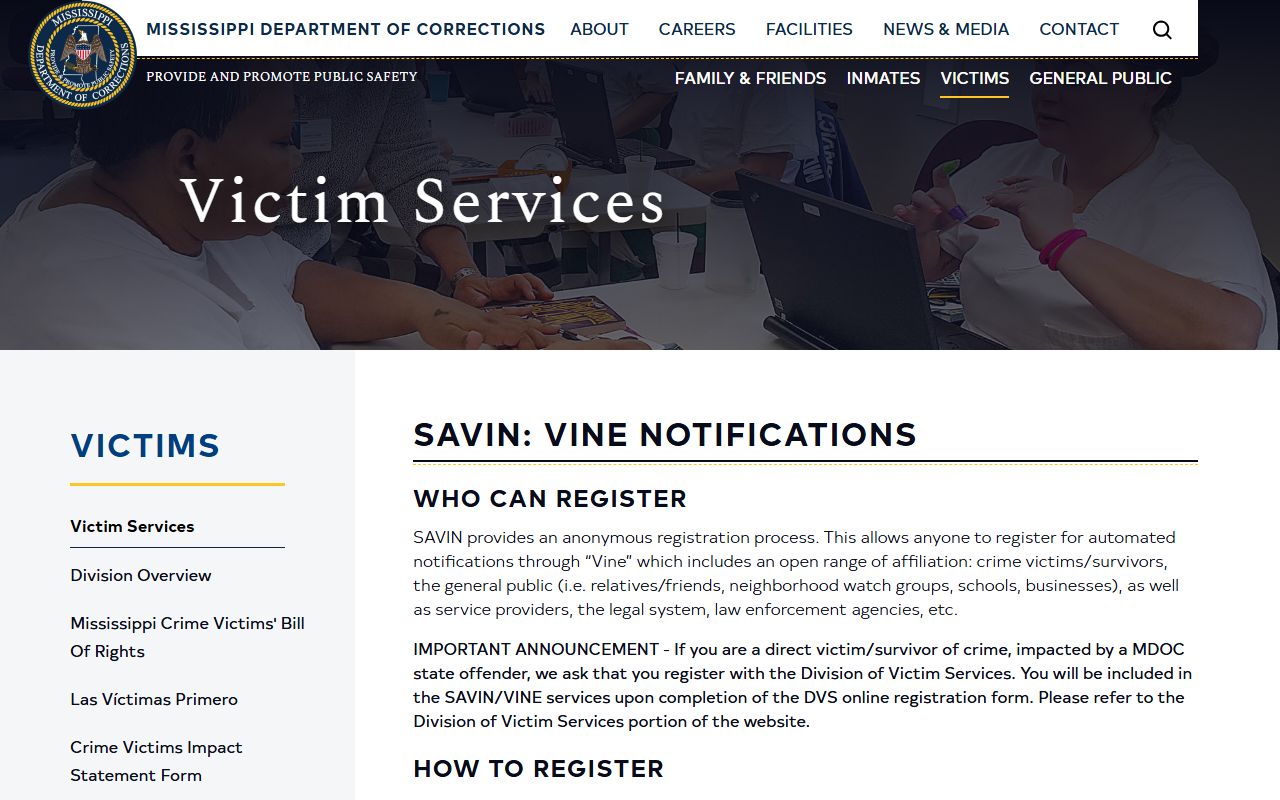
Registration is built for ongoing alerts, so it suits anyone tracking an arrested person's release rather than the underlying charge. Searches and sign-ups also run through the state portal directly.
The Mississippi VINE portal offers a custody-status lookup and notification sign-up in one place.

Even here the focus stays on custody and release, which makes VINE a companion to the court charge record, not a replacement for it.
Note: VINE and MDOC report custody and release status only, so neither confirms the specific charges a prosecutor filed in court.
Background Check Considerations
There is a difference between a casual record lookup and a formal background check. Pulling an Issaquena County arrest record to satisfy curiosity is not the same as screening someone for a job, an apartment, or a loan. Those regulated uses fall under the federal Fair Credit Reporting Act and must run through a compliant consumer reporting agency. A raw charge record can be incomplete, out of date, or later expunged, so it is a poor stand-in for a vetted report.
Important: This site is not a consumer reporting agency under the FCRA, and its information cannot be used for employment, tenant, credit, or other FCRA-regulated screening.
Restricted Issaquena County Charge Records
Not every charge is open to the public. Youth court records are confidential under Mississippi law, so juvenile charges do not appear in an ordinary search. Sealed cases carry a court order that limits access. Charges that were dismissed, dropped, or expunged may be pulled from public view entirely. Active investigations and unserved warrants can also stay private until the case is filed or the warrant is served. When a record is restricted, the right next step is the Circuit Clerk or the court that handled the case, not a third-party site.