
Criminal Court Records in Issaquena County
A criminal court record is the case file built around a single prosecution. It opens when charges are filed and grows with every event that follows. The clerk of court keeps it. In Issaquena County that clerk is Ronda Delaney, who serves as both Circuit Clerk and Chancery Clerk for the county. Her office holds the indictments, plea orders, judgments, and docket entries that make up the felony record, and it issues certified copies when a reader needs proof of an outcome.
Felony cases belong in Circuit Court. Issaquena County sits in the Ninth Circuit Court District with Sharkey and Warren Counties, and the court hears felony prosecutions, large civil suits, and appeals from the lower courts. Judges M. James Chaney Jr. and Toni Walker Terrett preside. Misdemeanor matters usually start in Justice Court or Municipal Court. Those lower cases reach the Circuit Court file only when they are appealed or tied to a felony, so a full criminal history can sit across more than one court.
The felony file may hold the indictment or information, arrest or capias references, bond orders, the arraignment, the plea, motions, continuances, trial entries, the verdict, the sentence, and any probation, revocation, or expunction flag. That spread of detail is what sets the case record apart from a one-line charge entry.
How to Search Issaquena County Criminal Court Records
The official online route for Circuit Court cases is Mississippi Electronic Courts and its public arm, Public Access to Mississippi Electronic Courts, known as PAMEC. Issaquena County Circuit Court appears on the Ninth Circuit Court District MEC system, which went live in July 2018. Public access is not an open search box on a county website. PAMEC asks the user to register a public account, and remote document viewing carries online charges. The county itself publishes no case-search portal, jail roster, or clerk search page, so the statewide system and the courthouse carry the load.
When remote access is not an option, the courthouse is the fallback. A reader can inspect public filings at a public terminal where one is available and ask the clerk for certified copies. The steps below trace the practical path for a felony case.
- Confirm the case is a felony. Felony prosecutions and many criminal dispositions live in Circuit Court, while misdemeanors and traffic cases sit in Justice or Municipal Court.
- Open the Ninth Circuit District MEC system for Issaquena County Circuit Court cases.
- Register a PAMEC public account for remote access. The public account path is separate from an attorney filing login.
- Search by the identifiers the system allows, such as case number or party name, then open the docket to read the plea and disposition.
- Request a certified copy from Ronda Delaney's office, or visit the courthouse, when a record is older, sealed, expunged, not digitized, or simply not found online.
For a statewide criminal history rather than one county file, Mississippi routes name-based and fingerprint background checks through the Department of Public Safety, and the state also runs a public sex offender registry. A single Circuit Court file shows one prosecution. A statewide history pulls cases together across counties. The charges that feed a case file are covered in more depth on the arrest records and court charges page.
Stages of a Felony Case in Circuit Court
A felony case moves through Circuit Court in set steps, and each step leaves a mark in the record. The charging document opens the file. Hearings and motions fill the middle. A plea or verdict closes the merits, and sentencing closes the case. Reading the docket in that order makes the file far clearer.
Case flow: Charges Filed › Arraignment › Pretrial / Motions › Plea or Trial › Disposition › Sentencing
Charges reach Circuit Court as an indictment from a grand jury or, in some cases, as a prosecutor-filed information. From there the file tracks every setting until the judge enters a final judgment. The table breaks down the core stages and what each one adds to the record.
| Stage | What Happens |
|---|---|
| Arraignment | The charges are read in open court and the defendant enters a plea of guilty, not guilty, or no contest where allowed. Bond conditions are often confirmed here. |
| Pretrial / Motions | Lawyers file motions, the court sets hearings, and the docket fills with continuances, bond changes, and orders. Plea negotiations often happen during this stretch. |
| Plea or Trial | The defendant pleads to a charge, or a 12-member jury hears the case. A judge may decide without a jury when the dispute is a question of law rather than fact. |
| Sentencing | After a guilty plea or verdict, the judge orders punishment, which may include prison, probation, fines, or conditions. The sentence and any final judgment are entered in the record. |
What an Issaquena County Criminal Court Record Shows
The fields in a felony file vary by case, but most public dockets identify the court, case number, party names, filing date, case type, status, the judge, docket entries, hearing settings, orders, and the disposition. A Circuit criminal case adds charge language, bond entries, plea status, the sentence, and flags for probation, revocation, sex-offender registration, or expunction. The table walks the core fields a reader meets when a case opens.
| Field | What It Shows |
|---|---|
| Case Number | The unique number the clerk assigns the felony file. It is the fastest way to pull a single case in the MEC system. |
| Defendant | The person charged, listed by legal name. Alternate spellings and aliases can matter when searching by name. |
| Charges | The indictment or information language describing each count, including the offense and any statute cited. |
| Plea | The defendant's formal answer, such as guilty, not guilty, or no contest, recorded at arraignment or later. |
| Disposition | The final outcome of each charge, from conviction or acquittal to dismissal or nolle prosequi. |
| Sentence | The punishment ordered after a conviction, which may list prison time, probation, fines, or conditions. |
Status flags ride alongside these fields and tell a reader where a case stands. The Ninth Circuit MEC system uses flags such as Plea Pending, Trial Pending, Nolle Pros Pending, Probation, Probation Violation Pending, Final Judgment Issued, Bench Warrant Issued, Capias Pending, Closed, Sealed, and Expunged. A flag like Pretrial Intervention Pending signals that a defendant may be headed into a treatment program rather than a standard sentence.
Charges vs. Convictions
Being charged is not the same as being convicted. A charge is an accusation. A conviction is the court's finding of guilt by plea or verdict. A criminal court record can show charges that were later dropped, dismissed, or ended in acquittal, and those entries stay in the file even when no conviction follows. Reading only the charge line, and stopping there, is the most common mistake people make with these records.
| Charge | Conviction | |
|---|---|---|
| Stage | Accusation | Verdict or plea |
| Burden of Proof | Probable cause | Beyond reasonable doubt |
| Outcome | May be dropped or dismissed | Leads to a sentence |
| Public Record | Yes | Yes |
The disposition field settles the question. A prosecutor may end a charge with a nolle prosequi, meaning the state chose not to proceed. A judge may dismiss a count outright. A jury may acquit. None of those outcomes is a conviction, even though the original charge remains visible in the docket.
Reading Issaquena County Dispositions and Sentences
The disposition is the final word on a charge. Common entries include guilty, not guilty, dismissed, and nolo contendere, which is a no-contest plea. A deferred outcome or a Pretrial Intervention Pending flag means the case is paused while a defendant completes a program, and the final disposition may change once that program ends.
A sentence reads as the punishment ordered after a conviction. It can list prison time served through the Mississippi Department of Corrections, probation under court supervision, fines, restitution, or set conditions. The record may then add a Probation flag, and a later Probation Violation Pending or Revocation entry signals that the supervised release is under review. A Final Judgment Issued flag tells a reader the case has reached its end. To track who is currently held after sentencing, the inmate records page covers the custody side.
Issaquena County District Attorney and Public Defender
Two offices shape almost every felony file. The District Attorney prosecutes the case for the state, and the public defender represents defendants who cannot afford private counsel. The Ninth Circuit District Attorney is Ricky Smith, reachable at 601-636-5754, and his office covers Issaquena, Sharkey, and Warren Counties. The DA appears on indictments and plea orders, screens candidates for intervention court, and may file motions such as nolle prosequi or revocation petitions. For a charge-status question, a reader can start with the Circuit Clerk for the filed court record or the DA office for prosecutor information.
On the defense side, Mississippi runs the Office of State Public Defender, which maintains public defender directories and training resources for the state. The image below comes from that office.
The Office of State Public Defender homepage sets out how appointed defense is organized across Mississippi.

The office lists a felony-level public defender entry serving Warren, Sharkey, and Issaquena Counties, mailing to P.O. Box 821887, Vicksburg, MS 39181, with phone 601-738-5866. Local courts assign appointed counsel for eligible defendants, so the public defender is part of the court ecosystem even though the office is not itself a records custodian.
Ninth Circuit Intervention Court Outcomes
Some Issaquena County felony files end in a treatment program rather than a standard prison term. The Ninth Circuit Intervention Court is the documented specialty court for the district. It is an intense rehabilitative probationary court built for crimes committed by people addicted to drugs or alcohol. The program mandates inpatient or intensive outpatient treatment, frequent drug testing, regular court appearances, unannounced home visits, 12-step meetings, employment, and, depending on need, GED classes. An information line for the program is 601-619-4323.
The detail of how the court runs comes from Judge Chaney's official page.
Judge Chaney's intervention court page explains how the Drug Court team serves Sharkey, Issaquena, and Warren Counties.

Acceptance is a team decision made after background and social screening and interviews, with the team drawing on attorneys, public defenders, the district attorney, treatment providers, law enforcement, and program staff. A participant pleads guilty to a non-violent felony and is ordered into the program for two to five years. If the participant succeeds, the conviction is set aside and expunged. If the participant fails, the original sentence takes effect. That outcome is why a case may carry a Pretrial Intervention Pending flag for an extended stretch before the disposition settles.
Finding Court-Appointed Counsel in Issaquena County
Defendants who qualify for appointed counsel can confirm who represents them through the state directory. The Office of State Public Defender keeps a searchable list of public defenders by county and division, which the directory page below makes available.
The public defender directory lets a reader locate the appointed counsel assigned to Issaquena County felony cases.
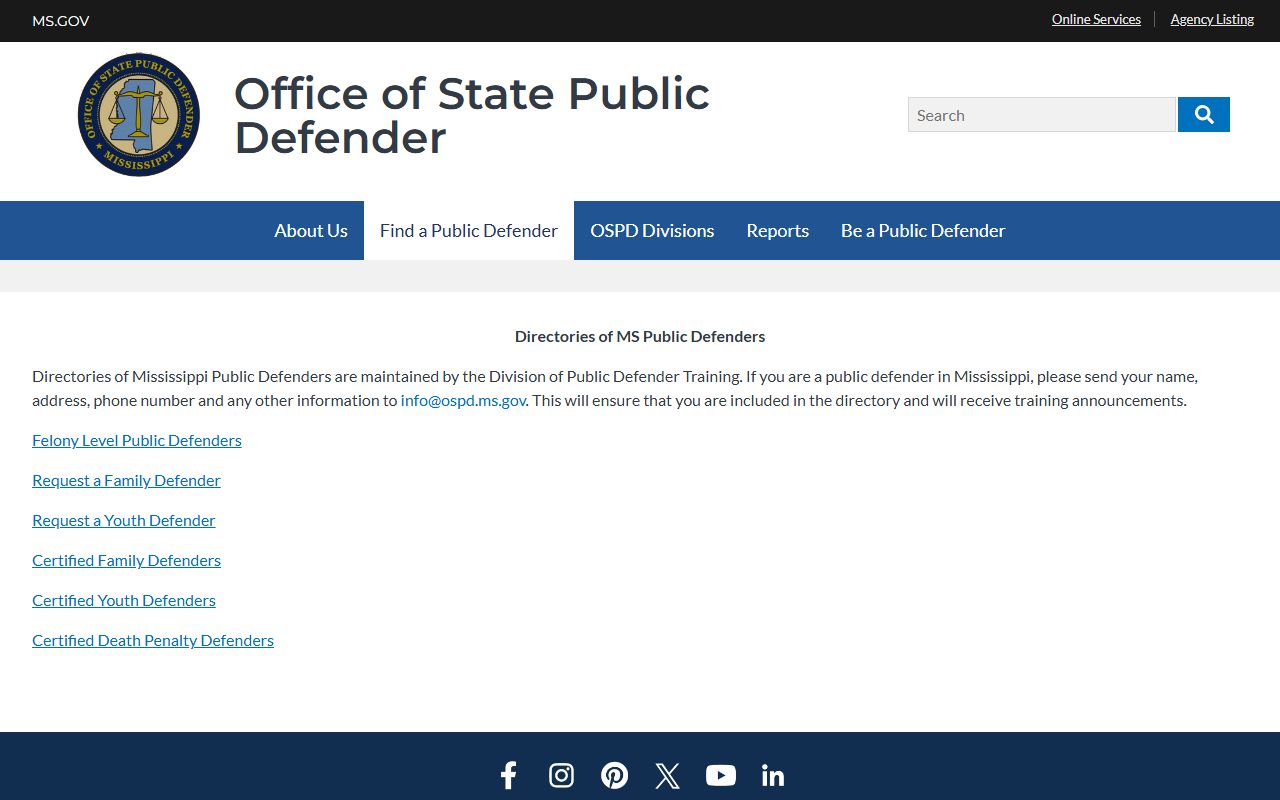
The directory is maintained by the Division of Public Defender Training, and the office asks defenders to send updated contact information to info@ospd.ms.gov. Because assignments are made through the local court, the surest confirmation of who handles a given case still comes from the Circuit Clerk's file or the courtroom record itself.
Sealed vs. Expunged Records
Sealing and expunction both pull a record out of ordinary public view, but they are not the same. A sealed case is hidden from the public while the file itself survives. An expunged case is treated as though it never existed, and the public docket may carry only an Expunged flag where the file once sat. The Ninth Circuit MEC system uses both a Sealed flag and an Expunged flag, and either one means the public-facing docket may be limited or unavailable.
| Sealed | Expunged | |
|---|---|---|
| Visibility | Hidden from public | Destroyed / treated as never existed |
| Law Enforcement | Limited access | Very limited |
| Eligibility | By court order or law for protected cases | Dismissed, acquitted, or qualifying charges under state law |
Mississippi expunction is court-based and runs through a petition. A person generally files in the court that handled the charge or conviction, cites the eligible category under Miss. Code Ann. Section 99-19-71, and asks the judge to order expunction. Non-conviction outcomes such as dismissed charges, dropped charges, acquittals, or no disposition can qualify. The state also allows expunction of certain convictions, including one qualifying conviction after statutory waiting periods and completion of sentence conditions, with exclusions. Public officials cannot expunge convictions tied to their official duties.
- Identify the court that handled the case. Felonies route through Circuit Court, while lower misdemeanors or traffic matters route through Justice or Municipal Court.
- Confirm the charge or conviction fits an eligible category under the state expunction statute.
- File a petition with that court and pay the clerk's filing fee.
- If the judge grants the order, the court sends it to the agencies that hold the record so public access can be removed or restricted.
For Issaquena County, the practical first step is naming the original court, then contacting the clerk for the correct filing channel and fee.
Public Access to Criminal Court Records
Felony case files are public records in Mississippi unless a statute, court order, or confidentiality rule says otherwise. Access starts with the court that keeps the file. Circuit Court dockets and documents route through MEC and PAMEC or through the clerk at 129 Court Street in Mayersville. The Mississippi Public Records Act supports inspection, but it does not override confidentiality laws, expunction orders, sealed cases, youth court rules, or redaction. When no online form exists, a written records request directed to the clerk is the proper path, and mail goes to P.O. Box 27, Mayersville, MS 39113.
Key Statutes:
Miss. Code Ann. Section 25-61-1 et seq. - the Public Records Act opens public records for inspection unless an exemption applies, and bars electronic recordkeeping from eroding that access.
Miss. Code Ann. Section 9-7-81 - Circuit Court is the broad trial court for matters not exclusively assigned elsewhere, which is why felony case files sit there.
Background Check Considerations
A casual case lookup and a formal background check are different things. Reading a single felony file in Issaquena County answers a narrow question about one prosecution. A background check used for hiring, housing, or credit must follow the federal Fair Credit Reporting Act, which sets accuracy and notice rules that a casual docket search does not. For employment-grade screening, Mississippi routes formal criminal history checks through the Department of Public Safety rather than a county docket.
Important: This site is not a consumer reporting agency under the FCRA, and its records may not be used for credit, employment, tenant, or insurance decisions.
Restricted Criminal Court Records in Issaquena County
Not every criminal-adjacent file is open. Youth court records are confidential under Miss. Code Ann. Section 43-21-251, and they are disclosed only as the law or a youth court order allows. A reader should not expect to find juvenile delinquency, abuse, or children-in-need-of-supervision cases through an ordinary public search. Sealed and expunged cases sit behind their flags. Ongoing matters may withhold detail until a setting concludes.
Personal identifiers are commonly redacted from the public version of a file. Social Security numbers, financial account numbers, dates of birth, minor children's names, and medical data may be masked or hidden even when the rest of the docket is open. When a file is older, not digitized, or restricted, the clerk's office at the Mayersville courthouse remains the place to confirm what can be released and how.
Note: A flag like Sealed or Expunged means the public docket may be limited, so confirm the current status with the clerk before relying on what a search returns.